

Board Performance · 2025
In this section14 topics
- Prevention of Conflicts of Interest4 items
- Prevention of the Use of Inside Information3 items
- Anti-Corruption6 items
- Whistleblowing5 items
- Selection of Directors & Chief Executives6 items
- Selection of Independent Directors2 items
- Director Development2 items
- Evaluation of Board & Subcommittee Performance3 items
- Subcommittees1 item
- Meeting Attendance & Remuneration3 items
- Supervision of Subsidiaries & Associated Companies4 items
- Board Duty Performance — Overview1 item
- Audit Committee Duty Performance1 item
- Executive Committee Duty Performance1 item
Prevention of Conflicts of Interest
Introduction
Khon Kaen Sugar Industry Public Company Limited has established a policy requiring the disclosure of Conflict of Interest between personal interests and the company's interests to prevent activities that may result in conflicts of interest, illegal activities, and inappropriate conduct. The Board of Directors has established a Conflict of Interest Policy based on the principle that any decision made by personnel at all levels in conducting business activities must be made in the best interests of KSL. It is the responsibility of all personnel to consistently examine themselves for any vested interests or conflicts of interest in their work performance and to comply with the Company's Guidelines on Conflict of Interest Prevention Measures. These measures include requiring personnel who have involvement or connections with matters under consideration to disclose such relationships or connections to the Company, and they must not participate in the consideration or decision-making process, nor have authority to approve or be involved in such transactions.
Has the Company Acted to Prevent Conflicts of Interest?
Yes
Operations in the Past Year
The Company has prepared the Conflict of Interest Guidelines in November 2024 and conducts ongoing training for employees at all levels to ensure understanding before disclosing potentially conflicting transactions through the designated disclosure forms established by the Company. Directors, executives, and all employees are required to submit annual disclosure reports regarding any suspected conflicts of interest involving themselves or related family members that may conflict with the Company's interests, as well as whenever such transactions are identified.
From November 1, 2024 to October 31, 2025, a total of 2,015 directors, executives, and employees at all levels submitted annual conflict of interest reports, representing 60 percent of all employees. Among all disclosures made, no violations of good practices in accordance with the ethics and code of conduct regarding conflict of interest in business operations were found. The Company's conflict of interest disclosure form includes an acknowledgment that any violation of or failure to comply with the Company's business ethics and code of conduct constitutes a disciplinary offense subject to disciplinary action according to the penalty procedures and the severity of the violation. In 2025, no cases of conflict of interest violations constituting disciplinary offenses were identified.
Nevertheless, training activities to educate employees before disclosing conflict of interest matters will continue in 2026 to ensure that all employees have knowledge and understanding and participate with the Company in preventing conflicts of interest and achieving the goal of 100 percent disclosure. Once employees at all levels have a thorough understanding of conflict of interest prevention measures, the Company plans to develop an electronic disclosure system through the KSL Intranet for annual submissions going forward.
Number of Conflict-of-Interest Cases
| Metric | Current Year | Previous Year | Two Years Ago |
|---|---|---|---|
| Total number of cases or issues related to conflicts of interest (cases) | 0 | 0 | 0 |
Prevention of the Use of Inside Information
Has the Company Acted to Prevent the Use of Inside Information?
Yes
Operations in the Past Year
The Company has established a written policy regarding the use of inside information to prevent directors, executives, and employees from utilizing material non-public information of the Company for their own benefit or for the benefit of others. This policy also governs the disclosure of interests and relationships in transactions that may involve conflicts of interest, as well as the trading of the Company’s securities and the reporting procedures for securities holdings, all of which are conducted in accordance with the Company's corporate governance policy.
The company has continuously communicated and provided knowledge regarding insider trading prevention to directors, executives, and employees through regular policy and practice dissemination via training sessions, including testing to assess understanding, to ensure proper and appropriate compliance with the company's established guidelines.
The Corporate Secretary has sent email reminders to directors and executives of the group companies regarding blackout periods for trading the company's securities, one month in advance of financial statement announcements.
During 2025, the company found no violations and received no tips or complaints related to insider trading. Additionally, no directors or executives of the group companies were found to have traded the company's securities during the blackout periods designated by the company, in compliance with laws, regulatory requirements, and the group's good corporate governance principles.
The company has provided insider trading prevention training to 100% of all directors and executives, and 70% of employees have received the training. The company continues to conduct ongoing training to cover all employees.
Over the past year, the company found no cases of unfair practices or exploitation of investors through the use of inside information by directors or executives of the company.
Number of Inside-Information Cases
| Metric | Current Year | Previous Year | Two Years Ago |
|---|---|---|---|
| Total number of cases or issues related to the use of inside information to seek benefits (cases) | 0 | 0 | 0 |
Anti-Corruption
Introduction
The Company conducts its business on the foundation of transparency, ethics, and compliance with policies and laws related to the prevention of and opposition to fraud, corruption, and the giving or receiving of bribes or improper benefits to or from government officials or private sector parties. The Company has established an organizational structure with clearly defined responsibilities, work processes, and chains of command for each unit to ensure proper checks and balances and appropriate inter-departmental oversight. In this regard, the Company has prepared an Anti-Fraud and Anti-Corruption Measures Manual that consolidates policies, codes of conduct, regulations, rules, and various procedures for the Company's directors, executives, and employees to comply with.
The Company has assigned the Risk Management Department, in collaboration with the Risk Management and Anti-Fraud and Corruption Working Group, to assess fraud and corruption risks using the COSO-ERM framework and to prepare the Fraud Risk Management Manual and the Anti-Fraud and Anti-Corruption Measures Manual. The team also monitors fraud and corruption risks based on previously assessed self-evaluation criteria by coordinating with operational personnel from all departments and the Internal Audit Office. Additionally, various activities are continuously conducted to communicate and build understanding of policies and good practices in combating fraud and corruption. The Company has a strategy to extend these efforts to stakeholders to progressively bring them into alignment with Thailand's Private Sector Collective Action Against Corruption.
Operations — Introduction
In 2025, the Company conducted significant anti-fraud and anti-corruption activities as follows:
Reviewed the Anti-Fraud and Anti-Corruption Policy and Measures Manual, including provisions on reporting misconduct and fraud, to serve as guidelines for investigating misconduct and fraud, reporting misconduct and fraud, penalizing offenders, and protecting whistleblowers.
Developed a training course on fraud and corruption risk assessment and anti-corruption measures for executives and supervisory-level employees to enable personnel to analyze fraud and corruption risks within their respective units and utilize the assessment results to plan operational improvements for greater efficiency. A total of 295 employees participated in the activities, representing 53.4 percent of all supervisory-level employees.
Published the Anti-Fraud and Corruption Policy and the Anti-Fraud and Anti-Corruption Measures Manual on the Company's website and Intranet to ensure that the Company's directors, executives, and employees at all levels are informed and adopt them as guidelines for their work practices.
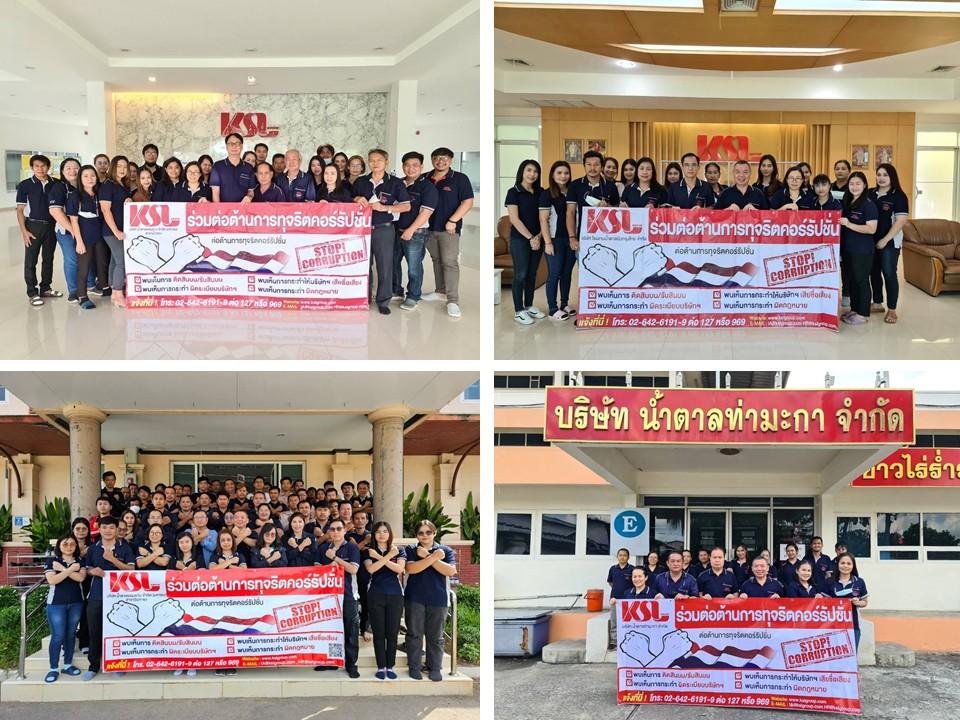
Promoted anti-fraud and corruption initiatives and whistleblowing channels through signage at the entrance of all factories to communicate the anti-corruption policy and reporting channels to external parties.
Communicated and disseminated the Anti-Corruption Policy and Measures Manual to business partners through letters requesting cooperation and acknowledgment letters confirming their alignment with the Company in combating fraud and corruption. A total of 91 business partners acknowledged their participation in the collective action, representing 100 percent of all business partners according to the plan set for 2025.
Conducted annual orientation training for new employees, incorporating work ethics and anti-fraud and corruption as mandatory topics that new employees must understand and adopt as guidelines for their work practices.
Conducted satisfaction surveys on anti-corruption operations to utilize the data for improving related work. The results showed that 100 percent of employees who participated in the activities had a good understanding, and 100 percent of employees were satisfied with the communication, training sessions, and various activities at a good to excellent level.
Has the Company Acted on Anti-Corruption?
Yes
Operations in the Past Year
The Company has participated in the CAC (Thai Private Sector Collective Action Against Corruption) program by utilizing the 71-item self-assessment questionnaire as criteria for continuous operational development. The Company has been certified as a CAC member for three terms, and in September 2025, submitted documentation to apply for the fourth term of membership certification. It is expected that the certification will be renewed for another three years (2026 - 2028)
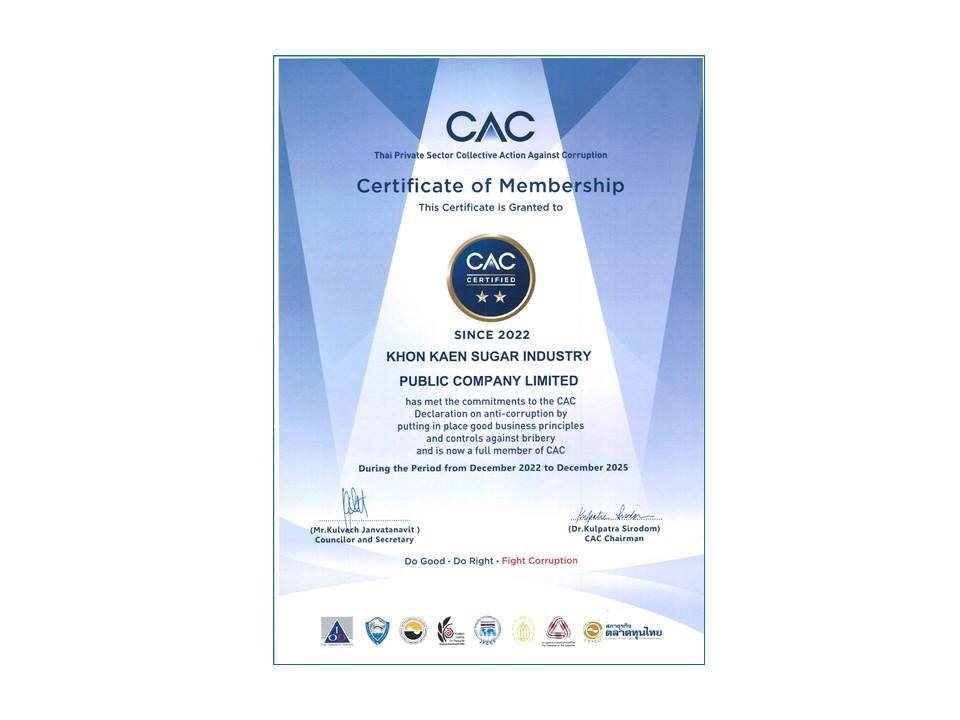
Form of Anti-Corruption Operations
| Operation |
|---|
| Review of appropriateness in anti-corruption |
| The participation in anti-corruption projects |
| Assessment and identification of corruption risk |
| Communication and training for employees on anti-corruption policy and guidelines |
| The monitoring of the evaluation of compliance with the anti- corruption policy |
| Review of the completeness and adequacy of the process by the Audit Committee or auditor |
Number of Corruption Cases
| Metric | Current Year | Previous Year | Two Years Ago |
|---|---|---|---|
| Total number of cases or issues related to corruption (cases) | 0 | 0 | 0 |
Whistleblowing
Introduction
Principles
Stakeholders who have the Company's interests in mind, or those who have suffered harm from actions by the Company or its employees, should have appropriate channels to provide information or file complaints that are useful for preventing or deterring misconduct or fraud. Those who provide information or file complaints must receive appropriate protection to ensure they do not suffer adverse consequences from providing information or making complaints in good faith.
Policy
The Company provides multiple whistleblowing channels (whistle-blower hotline) for reporting tips or information regarding misconduct and fraud, or for filing complaints, to enable stakeholders to provide useful information for investigation, prevention, and deterrence of misconduct or fraud, or to lodge complaints for remedial action.
Whistleblowers have the right to choose to remain anonymous but must provide sufficient factual details or evidence to enable the Company to investigate and determine whether there has been misconduct, fraud, or violation of the Company's rules and regulations.
The Company has measures in place to protect the rights of whistleblowers or complainants from actions that adversely affect their employment status or job performance, or from other unfair treatment, to build confidence among those who wish to provide information beneficial to the Company.
Operations — Introduction
Whistleblowing activities in 2025 were conducted in conjunction with training courses on fraud and corruption risk assessment and orientation, with whistleblowing channels included as a mandatory topic in the course curriculum to ensure employees are aware of the reporting channels established by the Company, including demonstrations on how to submit reports through the Company's website. Additionally, signage promoting whistleblowing channels was installed at all factories to communicate with both internal and external parties.
Has the Company Implemented Whistleblowing Procedures?
Yes
Operations in the Past Year
The Internal Audit Office, which serves as the center for receiving complaints and whistleblowing reports regarding fraud and corruption, as well as monitoring, protecting, and ensuring fair treatment of complainants or whistleblowers related to fraud within the organization, reports the status of complaints and tips to management and the Audit Committee on a quarterly basis. In 2025, no complaints regarding fraud or corruption were received.
Number of Whistleblowing Cases
| Metric | Current Year | Previous Year | Two Years Ago |
|---|---|---|---|
| Total number of cases or issues received through whistleblowing channels (cases) | 0 | 0 | 0 |
Selection of Directors & Chief Executives
Selection — Introduction
The powers, duties, and responsibilities of the Board of Directors are defined by reference to the Public Limited Companies Act, the Securities and Exchange Act, the regulations of the Stock Exchange of Thailand, and the company's regulations.
Are Directors Selected Through the Nomination Committee?
Yes
Are Chief Executives Selected Through the Nomination Committee?
No
Number of Directors from Major Shareholders
13
Rights of Minority Shareholders on Director Appointment
The company has clearly defined corporate governance policies related to minority shareholders, establishing a systematic process for shareholders' rights in the appointment of directors, specifically: "The company provides shareholders the opportunity to vote for the election of directors on an individual basis, by nominating directors for shareholders to vote on one by one." Furthermore, the company has provided shareholders with the opportunity to nominate qualified individuals for consideration in the election as company directors.
Method of Director Appointment
| Method |
|---|
| Method whereby each director requires approval votes more than half of the votes of attending shareholders with voting rights |
Selection of Independent Directors
Criteria for Selecting Independent Directors
Definition of Independent Director
An independent director must possess complete qualifications as prescribed by the Capital Market Supervisory Board and must be able to safeguard the interests of all shareholders equally without conflicts of interest. Additionally, they must be able to attend Board of Directors meetings and provide independent opinions.
Qualifications of Independent Directors
The company's corporate governance policy establishes the qualifications of independent directors as follows:
Holds no more than 0.5% of the total voting shares of the company, subsidiaries, associated companies, major shareholders, or controlling persons of the company, including shares held by related persons of that independent director.
Is not or has not been an executive director, employee, staff member, advisor receiving regular salary, or controlling person of the company, subsidiaries, associated companies, or major shareholders, unless having been free from such characteristics for at least two years prior to the date of appointment as an independent director.
Is not a person related by blood or legal registration as parent, spouse, sibling, or child, including spouse of child, of executives, major shareholders, controlling persons, or persons to be nominated as executives or controlling persons of the company or subsidiaries.
Does not have or has not had business relationships with the company, subsidiaries, associated companies, major shareholders, or controlling persons of the company in a manner that may impede independent judgment, including not being or having been a significant shareholder or controlling person of those having business relationships with the company, subsidiaries, associated companies, major shareholders, or controlling persons of the company, unless having been free from such characteristics for at least two years prior to the date of appointment as an independent director.
Is not or has not been an auditor of the company, subsidiaries, associated companies, major shareholders, or controlling persons of the company, and is not a significant shareholder, controlling person, or partner of an audit firm where the auditor of the company, subsidiaries, associated companies, major shareholders, or controlling persons of the company is affiliated, unless having been free from such characteristics for at least two years prior to the date of appointment as an independent director.
Is not or has not been a provider of any professional services, including legal advisory or financial advisory services, receiving service fees exceeding two million baht per year from the company, subsidiaries, associated companies, major shareholders, or controlling persons of the company, and is not a significant shareholder, controlling person, or partner of such professional service provider, unless having been free from such characteristics for at least two years prior to the date of appointment as an independent director.
Is not a director appointed to represent directors of the company, major shareholders, or shareholders who are related to major shareholders.
Does not operate a business of the same nature and in significant competition with the business of the company or subsidiaries, or is not a significant partner in a partnership, or an executive director, employee, staff member, advisor receiving regular salary, or holds more than 1% of the total voting shares of another company that operates a business of the same nature and in significant competition with the business of the company or subsidiaries.
Does not have any other characteristics that prevent the ability to provide independent opinions regarding the company's operations.
Board Charter Director Qualifications
The Board Charter establishes director qualifications as follows:
Possesses qualifications prescribed by relevant laws and regulations.
Has knowledge, capability, experience, and specialized expertise beneficial to the company.
Has no conflicts of interest with the company.
Has sufficient time to perform duties as a company director effectively, and directorship in other companies must not obstruct the performance of duties as a director of the company. Directors should not hold more than 5 directorships in listed companies simultaneously.
Criteria and Process for Recruiting Independent Directors and Senior Executives
The Nomination Committee is responsible for recruiting persons with appropriate qualifications (according to the Board Charter and Authorization Manual) by considering names in the database of the Thai Institute of Directors Association (IOD) Director Registry, including using the Board Skill Matrix as supplementary information for director nomination consideration, and inviting the Board of Directors to propose names. Once all names are obtained, the Nomination Committee will verify minimum qualifications as specified in the corporate governance policy, Board Charter, and company regulations, considering specialized knowledge and capabilities according to the company's current needs as predetermined, taking into account the company's vision, mission, and alignment with the company's strategy.
Did Any Independent Director Have a Business or Professional Relationship?
No
Director Development
Development of Directors in the Past Year
Regarding directors, the corporate governance policy stipulates that the company supports continuous training and knowledge development for the company's directors and executives, particularly through various training courses organized by external organizations such as the Stock Exchange of Thailand and the Thai Institute of Directors Association, to enable the company's directors to perform their duties and oversee the company's operations effectively.
The company sends directors to attend various training courses at multiple institutions, such as the Chairman Program, Director Accreditation Program (DAP), Director Certification Program (DCP) offered by the Thai Institute of Directors Association (IOD), essential foundation courses for audit committee members, various courses on new knowledge organized by the Stock Exchange of Thailand, and professional institutes.
Qualifications for Director Selection
| Qualification | Skill & Expertise |
|---|---|
| Possesses knowledge, capability, and experience in organizational management, with leadership skills, strategic formulation and implementation, as well as systematic business management to support the organization's sustainable growth. | 157 · Description: Project Management · 158 · Description: Corporate Management · 163 · Description: Leadership · 164 · Description: Strategic Management · 1683 · Description: Business Administration |
| Possesses knowledge, capability, and experience in agricultural business, food and beverage industry, sugar industry, as well as industrial materials, machinery, and engineering, with the ability to effectively apply technical and management knowledge in business development and operations. | 113 · Description: Agribusiness · 114 · Description: Food & Beverage · 122 · Description: Industrial Materials & Machinery · 159 · Description: Engineering |
| Possesses knowledge, capability, and experience in economics, commerce, accounting, and finance, with the ability to analyze, plan, and manage financial and business matters appropriately. | 112 · Description: Economics · 133 · Description: Commerce · 143 · Description: Accounting · 144 · Description: Finance |
| Possesses knowledge, capability, and experience in information and communication technology, marketing, and information technology management, with the ability to apply technology to enhance operational efficiency and business competitiveness. | 140 · Description: Information & Communication Technology · 142 · Description: Marketing · 150 · Description: IT Management |
| Possesses knowledge, capability, and experience in law, risk management, and auditing, with the ability to oversee operations to ensure compliance with laws, good governance principles, and appropriate internal controls. | 141 · Description: Law · 165 · Description: Risk Management · 166 · Description: Audit |
| Possesses knowledge, capability, and experience in sustainability and ESG operations, corporate social responsibility, as well as corporate governance and oversight, with the ability to establish policies, supervise, and drive the organization towards sustainable growth in accordance with good governance principles. | 145 · Description: Corporate Social Responsibility · 147 · Description: Sustainability · 265 · Description: Governance/ Compliance |
| Possesses knowledge, capability, and experience in human resource management, with the ability to plan, develop, manage, and oversee human resources in alignment with organizational strategy and sustainable growth. | 146 · Description: Human Resource Management |
Evaluation of Board & Subcommittee Performance
Criteria for Evaluating Board Performance
Performance Assessment
The Board of Director stipulates the conduct of self-assessment by applying the pattern developed by the Securities Exchange as follows:
Self-assessment Form of the Board of Directors
Self-evaluation Form of subcommittees, namely, Audit Committee, Nomination and Remuneration Committee, Risk Management Committee, Corporate Governance and Sustainable Development Committee.
Self-evaluation Form of individual directors so that the directors may jointly review their performance, solve problems and obstacles as well as the evaluation of the past performance and the ways to improve efficiency in the next year which leads to development in accordance with good governance.
Self-Assessment Procedures-The Whole Board of Directors
To evaluate the performance of the directors in 6 main items under SET guideline as follows :
Structure and characteristics
Roles/duties/responsibilities
Meeting
Performance of duties
Relationship with management
Self-development of directors and executive development
The Criteria of Self-Assessment-The Whole Board of Directors
The Board of Directors is the one who approve and review the assessment form to be correct in accordance with the criteria specified.
The Office of Company Secretary and Legal the tabulation is processed, the result shall be sent to the Board for consideration.
Self-Assessment Procedures-Each Director
To evaluate the performance of the directors in 3 main items under SET guideline as follows :
Structure and characteristics
Roles/duties/responsibilities
Meeting
The Criteria of Self-Assessment- Each Director
The Board of Directors is the one who approve and review the assessment form to be correct in accordance with the criteria specified.
The Office of Company Secretary and Legal the tabulation is processed, the result shall be sent to the Board for consideration.
Self-assessment of the Committee
To evaluate the performance of the directors in 3 main items under SET guideline as follows :
Structure and characteristics
Roles/duties/responsibilities
Meeting
Including with the Self-Assessment Criteria - the Entire Sub-committees
The Board of Directors is the one who approve and review the assessment form to be correct in accordance with the criteria specified.
The Company Secretary and Legal Office will summarize the results and present the assessment results to the Board of Directors for consideration.
Evaluation of Board Performance in the Past Year
The company conducts annual evaluations of the Board of Directors' performance in accordance with good corporate governance principles and practices. The Office of Corporate Secretary and Legal Department is responsible for collecting, summarizing evaluation results, and systematically presenting such results to the Board of Directors for consideration.
The individual director performance evaluation results were at the "Excellent" level with an overall average score of 3.64 out of 4, while the collective Board performance evaluation had an average score of 3.55 out of 4, reflecting the effectiveness of corporate governance oversight and overall performance of the Board of Directors.
The Board of Directors considered these evaluation results at Meeting 1/2026 (B.E. 2569) on December 19, 2025 (B.E. 2568), with comprehensive discussion, observations, and recommendations, to utilize the evaluation results as guidelines for continuous improvement of directors' performance and strengthening of good corporate governance, which will support the company's sustainable business growth.
Evaluation Results
| Evaluated Body | Group — Carried Out? | Group — Grade / Average Score | Group — Grade / Full Score | Individual (Self-Assessment) — Carried Out? | Individual (Self-Assessment) — Grade / Average Score | Individual (Self-Assessment) — Grade / Full Score | Cross (Assessing Other Directors) — Carried Out? |
|---|---|---|---|---|---|---|---|
| Board Of Director | Y | 3.55 | 4.00 | Y | 3.64 | 4.00 | N |
| Audit Committee | N | Y | 3.67 | 4.00 | N | ||
| Other Subcommittee | N | Y | 3.72 | 4.00 | N | ||
| Other Subcommittee | N | Y | 3.66 | 4.00 | N | ||
| Other Subcommittee | N | Y | 3.95 | 4.00 | N |
Subcommittees
Subcommittees
| Results of the Subcommittee's Duty Performance |
|---|
Over the past year, the Nomination and Remuneration Committee has fully performed its duties in accordance with its assigned authority, duties, and responsibilities, with 100% director meeting attendance, reflecting commitment and responsibility in performing duties. Additionally, the committee conducted individual performance evaluations (self-assessment), achieving an average score of 3.72 out of 4, with results at the "Excellent" level, reflecting effectiveness in oversight, nomination, and determination of appropriate and fair remuneration in accordance with good corporate governance principles. |
Over the past year, the Risk Management Committee has fully performed its duties in accordance with its assigned authority, duties, and responsibilities, with a director meeting attendance rate of 93.75%, reflecting commitment and responsibility in overseeing the organization's risk management. Additionally, the committee conducted individual performance evaluations (self-assessment), achieving an average score of 3.66 out of 4, with results at the "Excellent" level, demonstrating effectiveness in establishing policies, overseeing, and monitoring risk management in alignment with the organization's strategy and objectives. |
Over the past year, the Corporate Governance and Sustainable Development Committee has fully performed its duties in accordance with its assigned authority, duties, and responsibilities, with 100% director meeting attendance, reflecting commitment and responsibility in corporate governance oversight according to good governance principles and driving the organization's sustainable development. Additionally, the committee conducted individual performance evaluations (self-assessment), achieving an average score of 3.95 out of 4, with results at the "Excellent" level, demonstrating effectiveness in establishing policies, overseeing, and monitoring operations related to corporate governance, sustainability, and ESG in alignment with the organization's strategy and objectives. |
Meeting Attendance & Remuneration
Meeting Attendance — Sub-section Introduction
For the Board of Directors’ meeting, the Board of Directors has scheduled the meeting more than six times per year by setting the meeting dates in advance throughout the year and notifying each director by making an annual meeting schedule. However, to achieve flexibility in the Company’s business operations each month, the Company arranges a meeting of the Executive Committee to make decisions according to the authority assigned by the Board of Directors. At each meeting of the Board of Directors, the Executive Committee shall bring the matters considered back to report to the Board of Directors so that the Board of Directors can continuously monitor, control, and supervise the performance of the management.
In 2025 (B.E. 2568), there were a total of 7 Board of Directors meetings, and an additional 1 meeting of non-executive directors (without management participation) to allow non-executive directors and non-management directors to express opinions on operations and management independently. In 2025 (B.E. 2568), the non-executive directors' meeting was held once on August 15, 2025 (B.E. 2568), and the Corporate Secretary communicated the opinions received from the meeting to management at the senior management meeting for further action. Meeting agendas and supporting documents are distributed to directors at least 7 days in advance to allow directors sufficient time to study the information on various matters.
Board meetings are held at least every quarter by setting the meeting date in advance throughout the year and informing each committee by making an annual meeting schedule. In the meeting of the Board of Directors, Chairman of the Board, Chief Executive Officer and/or President, and Company Secretary Jointly consider the topics on the board's agenda by ensuring that crucial matters are included, and that each director is independent to suggest beneficial matters on the agenda.
During the meeting, the Board's Chairman allocates sufficient time for the management team to present matters and directors to discuss significant issues generally. In addition, the chairman of the board encourages directors to use discretion in making decisions, paying attention to every agenda brought to the meeting, including corporate governance matters. Moreover, the Board of Directors meeting invites senior executives from each department to attend the meeting to present information, issues, and clarify details for decision-making, which creates a relationship between directors and senior management.
Furthermore, it is the access to add necessary information through inquiries of senior management. In some issues that there is insufficient information, the Company's directors can contact for additional information through the Company's secretary. In crucial cases, they will provide subsidiary independent opinions from consultants or external professionals.
The report of the Board of Directors' meeting shall consist of the date starting and ending time, a list of directors present and absent from the meeting, a summary of the main points of the proposed matter, a summary of discussion points and observations, board resolutions and opinions of directors who disagree.
The Company stores the reports of the Board of Directors' meetings in a paper-book form and in PDF format which can be easily searched but cannot be edited. The meeting attendance of the Board of Directors is recorded in numbers. They are disclosed as the Board of Directors' because the meeting is held every quarter. However, the Executive Committee meeting which is related to the Company's performance will be held every month, so the Executive Committee meeting report is also presented to the Board of Directors for acknowledgment.
Types of Remuneration of the Board of Directors
Board of Directors and Sub-Committee Remuneration
The company establishes appropriate remuneration policies and criteria for the Board of Directors, with approval sought from shareholders annually. The Nomination and Remuneration Committee conducts surveys of director and sub-committee remuneration by considering responsibilities and performance of the Board of Directors, as well as comparative data with leading companies listed on the Stock Exchange of Thailand and within the same industry with similar business size and characteristics, including the Thai Institute of Directors Association (IOD) director remuneration survey results, overall company performance, and dividend payments to shareholders.
In 2025 (B.E. 2568), the total remuneration for the Board of Directors shall not exceed 14,200,000 baht. The remuneration for the Board of Directors consists of:
Board of Directors Remuneration
Director remuneration is divided into 3 components:
Fixed Pay - paid to directors on a monthly basis
Director's Bonus - special remuneration paid to directors once annually, based on consideration of the company's operating results each year
Meeting Allowances - including Meeting Allowance for BOD (Board of Directors meetings) and Meeting Allowance for Subcommittees - remuneration paid to directors who attend each meeting, paid only to directors who participate in the meetings
The company has established director remuneration as approved by the Annual General Meeting of Shareholders on February 25, 2025 (B.E. 2568), comprising fixed pay, director's bonus, and meeting allowances.
Remuneration or Benefits Payable to the Board
| Metric | Amount (Baht) |
|---|---|
| Remunerations or benefits pending payment to the board of directors over the past year (baht) | 0 |
Supervision of Subsidiaries & Associated Companies
Does the Company Have Subsidiaries or Associated Companies?
Yes
Is There a Mechanism for Overseeing Subsidiaries and Associated Companies?
Yes
Mechanism for Overseeing Management of Subsidiaries
Mechanisms for Overseeing Management and Accountability of Operations in Subsidiaries and Associated Companies (Approved by the Board of Directors)
The company places importance on overseeing the operations of subsidiaries and associated companies to ensure efficiency, transparency, and compliance with good corporate governance principles. The Board of Directors has established and approved mechanisms for overseeing management and accountability of operations in subsidiaries and associated companies, to ensure business operations align with the group's policies, strategies, and objectives, including risk management and protection of interests of shareholders and all stakeholders.
Appointment of Representatives as Directors, Executives, or Controlling Persons According to Shareholding Proportion
The company appoints its representatives to serve as directors, executives, or controlling persons in subsidiaries and associated companies according to shareholding proportion, to oversee, monitor, and participate in management to ensure operations comply with the group's policies, strategies, and direction.
Defining Scope of Authority, Duties, and Responsibilities of Directors and Executives Representing the Company in Establishing Important Policies.
The company clearly defines the scope of authority, duties, and responsibilities of directors and executives representing the company, covering the establishment of important policies, approval of business plans, investments, and risk management, to ensure decision-making is prudent, transparent, and auditable.
Disclosure of Financial Position and Operating Results
Subsidiaries and associated companies must prepare and report financial position and operating results to the company regularly, to enable the Board of Directors and management to monitor, evaluate, and oversee operations appropriately.
Other Significant Transactions, Acquisition or Disposal of Assets
Significant transactions, including acquisition or disposal of assets by subsidiaries and associated companies, must be considered and approved according to prescribed authority and in accordance with company policy, as well as relevant laws and regulations.
Internal Control System of Core Business Subsidiaries Must Be Appropriate and Sufficiently Rigorous
The company requires subsidiaries conducting core businesses to have appropriate and sufficient internal control systems, covering financial, operational, and legal compliance aspects, with regular monitoring and evaluation of system effectiveness.
Oversight Mechanisms
| Mechanism |
|---|
| Sending representatives to act as directors, executives or controlling persons in proportion to shareholdings |
| Defining the scope of powers, duties and responsibilities of directors and executives who represent the company in setting important policies |
| Disclosure of financial information and operating results |
| Other important transactions |
| Acquisition or disposal of assets |
| Internal control system of the subsidiary operating the core business is appropriate and sufficient in the subsidiary operating the core business |
Board Duty Performance — Overview
Board Duty Performance — Overall Description
The company plans Board of Directors meetings in advance for the entire year, more than 6 times per year, to consider the principal agenda items determined for each year. However, if there are important matters, the Chairman of the Board of Directors will convene a meeting for such important matters, with advance notice of no less than the period prescribed by law. In 2025 (B.E. 2568), the Board of Directors held a total of 7 meetings, with a director meeting attendance rate of approximately 95.71%.
For Board of Directors meetings, at least half of the total number of directors must be present to constitute a quorum.
The Board of Directors has established a policy regarding the minimum quorum at the time directors vote at Board meetings, requiring the presence of no less than 2/3 of the total number of directors.
In 2025 (B.E. 2568), the company provided facilities for meetings via electronic media to enable directors to attend Board of Directors meetings and provide comments or beneficial recommendations to management or the company's operations, in accordance with the Emergency Decree on Electronic Meetings B.E. 2563 (2020) and relevant regulations.
Audit Committee Duty Performance
Results of the Audit Committee's Duty Performance in the Past Year
Over the past year, the Audit Committee has fully performed its duties in accordance with its assigned authority, duties, and responsibilities, with 100% director meeting attendance, reflecting commitment and responsibility in overseeing financial reporting, internal control systems, risk management, and internal audit of the company. Additionally, the committee conducted individual performance evaluations (self-assessment), achieving an average score of 3.67 out of 4, with results at the "Excellent" level, demonstrating effectiveness in performing duties independently, transparently, and in accordance with good corporate governance principles.
Executive Committee Duty Performance
Results of the Executive Committee's Duty Performance in the Past Year
Over the past year, the Executive Committee has fully performed its duties in accordance with its assigned roles and responsibilities, with regular meeting attendance. Directors had an average meeting attendance rate of 90%, reflecting commitment, responsibility, and participation in overseeing and driving the company's operations in accordance with established policies and strategies.